Agriculture in France faces the shortage of skilled workers annually. France is best known for its agricultural production. Modern agribusiness depends on precision equipment. Due to massive agricultural production, many job roles are available; each one is distinct and depends on the qualifications.
Currently, tractor operator roles are trending due to an increase in agribusiness; experienced tractor operators capable of maneuvering 250 plus horse power tractors.
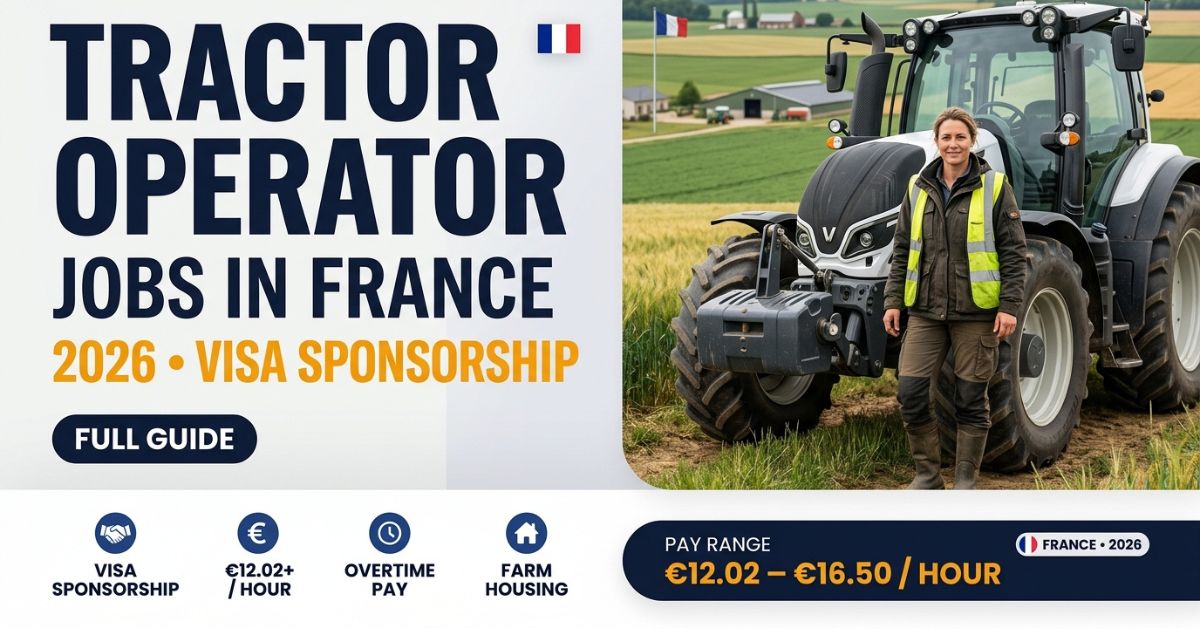
Tractor operator roles are best options for both national and international operators. For experienced international operators, tractor harvesting jobs in France with visa sponsorship in 202 offer legal minimum wages starting around €12.02 gross per hour.
These operator roles also come with overtime pay, structured lodging, and legitimacy to work in Europe and gain work experience through a permit.
If you are looking to work as a tractor operator in France, this guide is designed for you to highlight the overview, requirements, criteria, and guided steps on how to apply for tractor operator roles in France, along with visa sponsorship.
At a Glance: 2026 French Harvest Operator Overview
| Parameter | Regulatory Standard / Practical Reality |
| Statutory Minimum Wage (SMIC 2026) | €12.02 gross per hour (baseline agricultural wage) |
| Experienced Operator Range | €13.50 – €16.50 gross per hour (negotiated based on machinery) |
| Standard Workweek | 35 hours baseline (45–60+ hours during peak harvest windows) |
| Overtime Premiums | +25% (hours 36–43); +50% (hours 44+) |
| Peak Viticulture Season | Mid-August – Late October (Vendanges) |
| Peak Arable & Cereal Season | Late June – August (Grain/Straw); Sept – Nov (Grain Maize/Sunflower) |
| Driver’s License Requirement | Category B (minimum); Category C/CE or national tractor permits preferred |
| Legal Visa Route | Carte de Séjour Travailleur Saisonnier (Seasonal Worker Residence Permit) |
| Verified Job Platforms | France Travail, ANEFA (L’Agriculture Recrute), OuiJob Agriculture |
The Two Main Harvesting Tracks in France
Agricultural machinery roles in France split into two distinct operational environments: high-value, tight-clearance viticulture and expansive, high-tonnage broadacre cereal farming.
Seasonal Machinery Tracks
- Narrow & straddle units
- Steep slope navigation
- Grape bin logistics
- Key Regions: Champagne, Bordeaux, Burgundy
- 200–350+ HP tractors
- Combines & chaser bins
- Tillage & baling operations
- Key Regions: Paris Basin, Beauce, Centre-Val
1. Vineyard Tractor Driving (La Viticulture & Les Vendanges)
Vineyard machinery driving demands high spatial awareness and delicate handling. French vineyards especially in heritage Appellation d’Origine Protégée (AOP) areas are planted with tight row spacings (often 1.0 to 1.5 meters) on steep inclines.
- Machinery Deployed: Narrow-track orchard tractors (Fendt 200 V/F Series, New Holland T4F, John Deere 5G Series) and specialized high-clearance straddle tractors (tracteurs enjambeurs).
- Primary Responsibilities: Hauling grape collection hoppers (bennes à vendange) between picking teams and processing stations, operating inter-row cultivators, and shuttling equipment across terraced hillsides.
- Peak Window: Mid-August through October.
- Prime Regions: Champagne (Marne), Bordeaux (Gironde), Burgundy (Côte-d’Or), Alsace, and the Rhône Valley.
2. Arable and Cereal Harvesting (Grandes Cultures)
Broadacre farming in France mimics large-scale grain belts in North America or the UK. Operations are mechanized, fast-paced, and run long daily shifts when weather windows open.
- Machinery Deployed: Heavy tractors (Claas Axion, John Deere 6R/7R/8R, Fendt 700/900 Vario, Case IH Puma), grain chaser bins (bennes céréalières), square balers, and combine harvesters (Claas Lexion, New Holland CR, John Deere S-Series).
- Primary Responsibilities: Chaser-bin chase cart operation directly alongside combine harvesters, road haulage to regional grain elevators (silos de collecte), high-density straw baling, and post-harvest stubble cultivation.
- Peak Window: Late June to August (Barley, Wheat, Rapeseed), transitioning to grain maize and sunflower harvesting from September through November.
- Prime Regions: The Paris Basin, Centre-Val de Loire (the Beauce granary), Grand Est, and agricultural lowlands across Brittany and Normandy.
Pay Rates, Overtime Regulations, and Accommodation Standards
Foreign workers in France benefit from the same labor protections as French nationals under the French Labor Code (Code du travail) and the National Agricultural Collective Bargaining Agreement (Convention collective nationale de la production agricole).
1. Legal Minimum Wage (SMIC 2026)
Agricultural seasonal workers cannot be paid less than the national statutory minimum wage.
- Base SMIC (2026): €12.02 gross per hour (approximately €9.50–€9.70 net per hour after statutory social contributions).
- Overtime Premiums (Heures Supplémentaires): The statutory French working week is 35 hours. During peak harvest seasons, special agricultural labor derogations permit up to 48 hours per week (or 60 hours with special labor inspector approval). Overtime pay is tiered:
- +25% pay increase for hours 36 through 43.
- +50% pay increase for every hour worked beyond 43 hours.
- Contractor & Skilled Bonuses: Experienced combine operators often negotiate flat gross rates between €14.00 and €16.50 per hour, sometimes accompanied by completion bonuses at the end of the harvest.
2. Accommodation and Board (Nourri et Logé)
French law requires employers providing housing to meet strict health, safety, and comfort standards.
- Lodging Standards: Accommodations must feature weather-tight private or semi-private rooms, clean sanitary facilities, drinking water, heating, and food preparation amenities (or fully catered meals). Typical setups include renovated farm gîtes, mobile homes, or dedicated seasonal worker quarters.
- Wage Deductions: If meals or lodging are provided, deductions from wages are legally capped by collective agreements (typically €5 to €7 per meal and modest daily lodging caps). Deductions must be itemized clearly on your official pay slip (bulletin de paie).
Operator Qualifications & Daily Language Prerequisites
Securing tractor driver jobs in France for foreigners requires verifying your operational competency before setting foot in the cab.
-
Driving LicenseCategory B (Min.)C / CE plus
-
Field Hours200+ hrsVerifiable references
-
Technical KnowledgeCVT / ISOBUSRadiators & Couplings
-
Basic FrenchRadio commandsRoad signage comprehension
- Driver’s License Requirements: A standard car license (Category B) is mandatory. Heavy agricultural combinations moving on French public highways increasingly require a Category C, CE, or a recognized national tractor qualification.
- Machinery Handling Proficiency: Farms rarely have time to train operators during harvest. You must be confident with:
- Setting up and troubleshooting ISOBUS implement terminals.
- Auto-guidance RTK-GPS interfaces (Trimble, GreenStar, Ag Leader).
- Safe public road towing of twin- and tri-axle trailers loaded up to 24–30 tonnes gross vehicle weight.
- Daily Preventative Maintenance: Greasing daily points (50+ nipples on modern balers and combines), checking engine and hydraulic oil levels, monitoring belt tension, and using compressed air to clear radiator screens.
Practical French Vocabulary for Equipment Drivers
English is the international language with a good score accross the world. But working in France the tractor operator must go with some of the necessary vocablualry words in order to communicate.
| French Term | English Meaning | Operational Context |
| La Moissonneuse-batteuse | Combine harvester | Grain and oilseed threshing |
| La Benne céréalière | Grain trailer / Chaser bin | Transporting grain from combine to silo |
| Le Tracteur enjambeur | Straddle tractor | High-clearance vineyard operations |
| La Prise de force (PDF) | Power Take-Off (PTO) | Coupling balers, shredders, or mowers |
| La Vidange en marche | Unloading on the move | Chaser bin positioning under the combine auger |
| L’Attelage trois points | Three-point hitch | Attaching cultivators and implements |
| Le Graissage | Greasing / Lubrication | Daily morning machine walkaround |
How to Get Visa Sponsorship for Farm Jobs in France (2026)
Non-EU/EEA citizens must have legal authorization to work in France. The primary legal vehicle for non-European machinery operators is the Seasonal Worker Residence Permit (Carte de Séjour Travailleur Saisonnier).
How the French Seasonal Work Visa Process Works
Employer posts opening on France Travail, conducts the mandatory labor market test, and issues your official seasonal employment contract.
Employer submits an online application for your Autorisation de Travail via the official DGEF foreign worker portal.
The French Ministry of the Interior approves the permit; digital clearance is dispatched directly to the French Consulate in your home country.
You attend an in-person appointment at VFS Global or TLScontact to submit biometrics and receive your Visa de Long Séjour — Travailleur Saisonnier.
1. The Seasonal Worker Permit (Travailleur Saisonnier)
- Duration: Authorizes agricultural work for up to 6 cumulative months per rolling 12-month period.
- Employer’s Responsibility: The French employer must apply for your work permit (Autorisation de Travail) online through the Directorate General for Foreign Nationals in France (Direction Générale des Étrangers en France – DGEF).
- Labor Shortage Advantage: Skilled tractor and agricultural machinery operators are officially classified under métiers en tension (occupations facing acute labor shortages) in several French départements. This classification waives or simplifies the domestic labor market test, allowing employers to hire non-EU talent faster.
- Worker Fee Ban: Under French labor law, the employer covers the administrative processing fee directly to the French Office for Immigration and Integration (OFII). No legitimate employer or agency will charge you a “visa fee” or “placement deposit.”
2. Working Holiday Visa (VVT / Permis Vacances-Travail)
If you hold citizenship in a country with a bilateral youth mobility agreement with France (including Australia, New Zealand, Canada, Japan, South Korea, and the UK) and are aged 18–30 (or 35 for select nationalities), the Working Holiday Visa allows you to work without requiring prior employer sponsorship. This makes landing seasonal machinery roles straightforward: you can apply directly to farms as a local resident.
Also Read: Test Lead Jobs UK 2026 | Scrumconnect Consulting Careers
Where to Find Openings: Top Platforms & Direct Networks
Avoid generalized international aggregator boards that often scrape outdated listings. Use the primary domestic channels used by French farmers and agricultural contractors.
1. France Travail (National Public Employment Service)
The primary government job portal (formerly known as Pôle Emploi).
- Target Search Terms: Search under Conducteur d’engins agricoles, Tractoriste viticole, or Chauffeur de tracteur céréalier.
- Filter: Set the contract filter to CDD Saisonnier (Fixed-Term Seasonal Contract).
- Website: francetravail.fr
2. ANEFA (L’Agriculture Recrute)
Managed by the National Association for Employment and Training in Agriculture (Association Nationale pour l’Emploi et la Formation en Agriculture), this is France’s premier agricultural-only board.
- Highlights: Lists farm-specific postings, machinery cooperative needs, and harvest crew calls across every French administrative region.
- Website: anefa.org
3. OuiJob Agriculture
A specialized commercial platform focusing on agricultural technicians, machinery operators, and contract harvesting crews.
- Website: ouijob.fr
4. Agricultural Contractors (ETAs) and Machinery Co-ops (CUMAs)
Many French farms outsource their harvest operations to ETAs (Entreprises de Travaux Agricoles) or share equipment through CUMAs (Coopératives d’Utilisation de Matériel Agricole).
- ETAs and CUMAs run large machinery fleets and employ specialized operators for continuous 2–3 month periods across multiple regional properties.
- Cold-contacting ETAs across the Centre-Val de Loire, Grand Est, and Nouvelle-Aquitaine with a clean machinery resume (CV Europass) is one of the most reliable ways to secure early harvest contracts.
Operator Self-Assessment Checklist
Confirm your readiness before applying to French agricultural managers:
- Tractor Seat-Time: At least 200–300 verifiable hours handling modern 150+ HP tractors or specialized orchard units.
- Trailer Road Handling: Confident reversing, turning, and balancing high-tonnage tandem-axle trailers through narrow European village streets.
- Daily Servicing: Capable of clearing chaff from combine engine bays, checking oil reservoirs, and greasing high-stress bearings independently.
- Documentation: Valid passport (valid at least 6 months beyond intended contract completion) and clear driver’s license.
- Language Basics: Conversational awareness of harvest commands (e.g., speed adjustments, radio coordination, bin changeovers).
Also Read: Carpenter Jobs in Russia with Visa Sponsorship 2026: Complete Guide
Frequently Asked Questions (FAQ)
What is the hourly wage for tractor operators in France for 2026?
Seasonal agricultural operators are protected by the national French statutory minimum wage (SMIC), which is €12.02 gross per hour in 2026. Skilled combine drivers and chaser-bin operators regularly negotiate higher base wages between €13.50 and €16.50 gross per hour, with additional legal overtime premiums (+25% to +50%) applied for hours worked beyond 35 hours per week.
Can non-EU citizens legally secure tractor driver jobs in France?
Yes. Non-EU citizens can work legally through two primary avenues: an employer-sponsored Seasonal Worker Residence Permit (Carte de Séjour Travailleur Saisonnier) backed by an official Autorisation de Travail, or a bilateral Working Holiday Visa (VVT) available to citizens of treaty nations aged 18 to 30 or 35.
When do harvest job applications open in France?
- Cereal and Grain Harvest (June–August): Application recruitment runs from January through April.
- Grape Harvest / Vendanges (August–October): Vineyard recruitment peaks between March and June.
Disclaimer: This guide is for educational and informational purposes. Please confirm all information from official sources before taking any step!
1 thought on “Tractor Harvesting Jobs in France with Visa Sponsorship: 2026 Operator Guide”